
10 questions that turn a party into an outreach
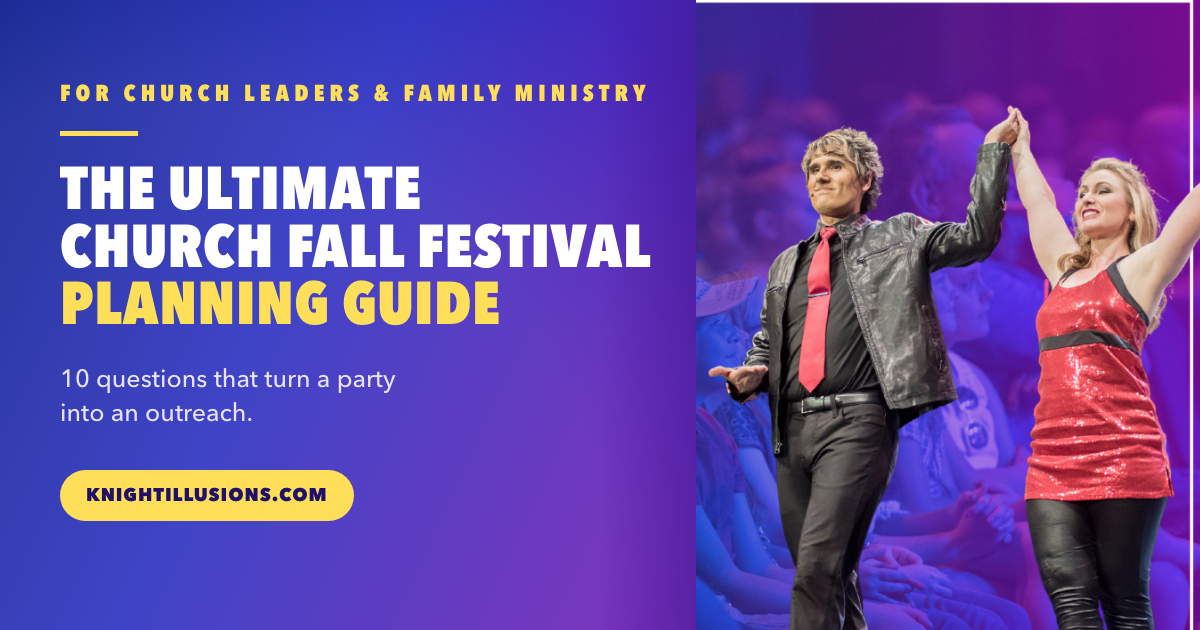
Your fall festival is probably the biggest front door your church opens all year.
Think about it. On one night in October, families who would never walk into a Sunday service will drive onto your campus, park in your lot, eat your food, and let their kids run around your building. They will meet your people. They will decide, in about fifteen minutes, whether this is a church that feels safe and warm or a church that feels like a sales pitch.
That is an enormous ministry opportunity. And most churches plan for it like it is a party.
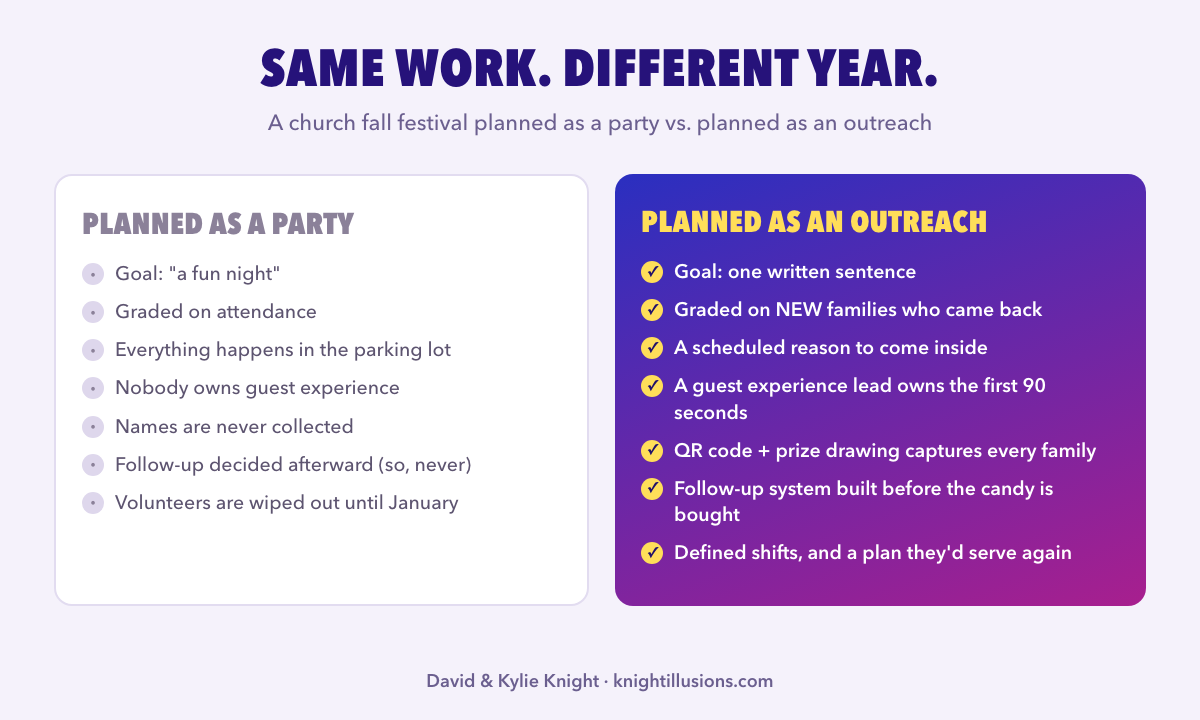
Here is the difference. A festival planned as a party gets graded on attendance. A festival planned as an outreach gets graded on relationships, and it is built from day one to produce them.
Both take the same amount of work. Only one of them changes your next twelve months.
So this is not another list of carnival game ideas. It is the ten questions we watch great church festival teams answer before they ever order a single pumpkin, plus run sheets, volunteer roles, follow-up messages you can copy, and the piece almost everybody skips: what happens on the Monday after.
Steal all of it. That is what it is here for.
Before the ten questions: name the win
Write one sentence and get your leadership to agree to it. Not three sentences. One.
“The win for our fall festival is ____________.”
Most church festivals are quietly trying to be three events at once, which is why they exhaust everybody and satisfy nobody. In our experience there are really only three honest wins:
1. Celebrate our own church family. A thank-you, a harvest party, a fun night for the people who already serve here. Nothing wrong with this! It is a legitimate, healthy win. Just say so out loud, because it changes your budget, your marketing, and your follow-up completely.
2. Open the doors to our community. You want families who have never been here to come, feel welcomed, and have a reason to come back. This is the one most churches SAY they want.
3. Raise money for a cause. A fundraiser with a festival attached, for missions, a local need, or a ministry partner.
Pick one as primary. The other two can come along for the ride, but they do not get to drive. If your win is “open the doors to our community,” then every question below has a different answer than it would for a harvest party, and you need to be honest about that in the very first planning meeting.
The 10 questions
1. What is your ONE goal, and does your budget actually match it?
Involve your church leaders and key volunteers in the decision-making from the very start. When you ask your leaders for feedback and ideas at the beginning, you are not just being polite, you are recruiting them. People protect what they helped build. They also have business connections you do not, and local business sponsorship is one of the fastest ways to fund a festival while strengthening your relationship with the community at the same time.
Then build a real budget and stick to it. Here are the line items that catch teams by surprise, so put every one of them on the page even if the number next to it is zero:
- Games, booths, and prizes
- Food and drink, plus serving supplies and food safety needs
- Inflatables, rentals, generators, extension cords, and lighting
- Entertainment
- Decorations and signage
- Promotion: printing, invitation cards, yard signs, boosted posts
- Volunteer costs: shirts, lanyards, coffee, dinner for the setup crew
- Safety: first aid supplies, wristbands, extra lighting, security
- The follow-up: printing for connection cards, and whatever your next-step event costs
- A contingency line of roughly ten percent, because something always comes up
A few decisions to make on paper before anyone gets excited:
- Free event, all-inclusive wristband, or per-game tickets?
- Who pays for what: church budget, sponsorships, ticket sales, or a mix?
- What is the single biggest line item, and is it pointed at your ONE goal?
That last question matters most. If your goal is drawing new families and most of your budget went to decorations that only your own people will notice, your budget and your goal are not on speaking terms.
2. Who is this really for, and does your front door feel that way?
Picture the actual family you are hoping to reach. A mom who is not sure whether her kids are supposed to wear costumes. A dad who has not been inside a church since he was twelve and is bracing to be asked for something. A grandparent who just wants somewhere safe to take the grandkids on a Thursday night.
Now walk your campus as that family. Where do they park? How do they know where to go? Who is the first human being who talks to them, and does that person have a name tag? Is there a single sign that tells them what is free and what is not?
Better yet, ask someone who does not attend your church to walk it with you and tell you what is confusing. They will spot in ten minutes what your team has stopped being able to see.
This is not decoration. This is the entire ballgame. A church with a modest festival and outstanding hospitality will out-minister a church with an inflatable obstacle course and a confused parking lot every single time.
3. Trunk or Treat, Harvest Festival, or Family Fun Night?
The name you choose tells your community what to expect, so choose on purpose.
- Trunk or Treat is the most understood name in the neighborhood and the easiest to explain to an unchurched family. It is also the most volunteer-heavy, because every decorated trunk is a household you have to recruit, coach, and supply.
- Harvest Festival feels warm and seasonal and sidesteps the Halloween conversation entirely, which for some congregations matters a great deal.
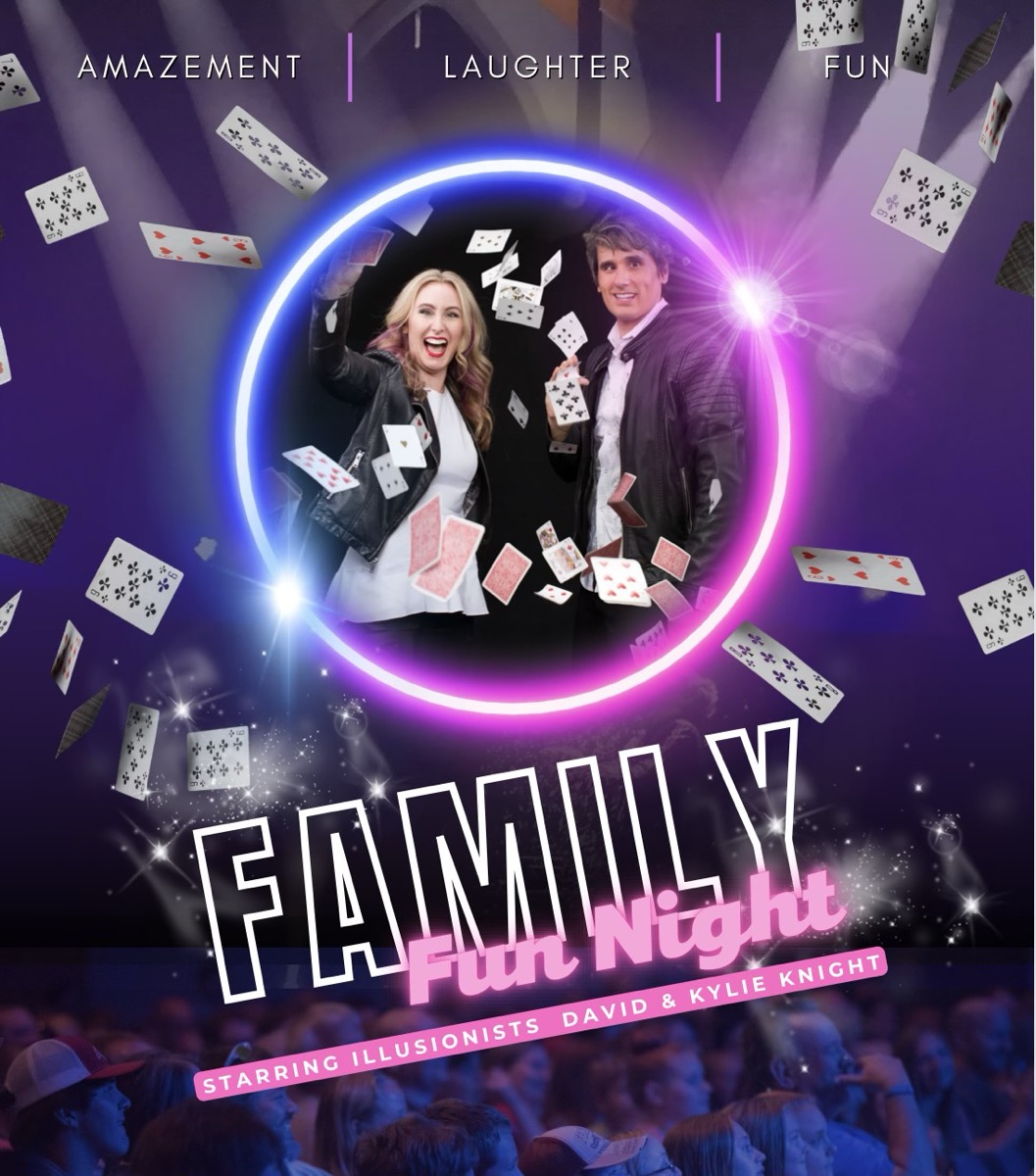
- Family Fun Night puts the emphasis where you actually want it: on families being together, not on candy. It also works beautifully for churches that want a scheduled, indoor, everyone-in-one-room moment.
On the Halloween conversation. Churches land in different places on this, and both places are held by thoughtful people who love Jesus. Some see the last week of October as the one night a year the whole neighborhood is already out looking for somewhere to go, and they want to be that somewhere. Others are not comfortable building an event on that calendar at all and would rather host something warm and seasonal in mid-October with no connection to the date.
You do not need us to settle that for you. What you do need is to settle it EARLY, with your leadership, in one conversation, and then be clear and kind about it in every piece of promotion you send out. The events that go badly are almost never the ones that picked the “wrong” side. They are the ones that never picked, and left volunteers and guests guessing.
Whatever you choose, build your theme, your decorations, and your games around it so the whole night feels like one idea instead of eight unrelated booths. And decide your costume policy early too, then communicate it clearly. Nothing makes a first-time family feel more out of place than showing up in the wrong thing.
4. What gets families out of the parking lot and INSIDE your building?
Here is the pattern we see over and over. The festival is in the parking lot. The church is in the building. And the families you most wanted to reach never once go inside.
You need a reason. A real one, on a schedule, that people plan their night around.
Something scheduled does exactly this. It gives families a break from the weather. It gives tired parents a chance to sit down together. It gets your community into your auditorium, in your seats, laughing with your people. It gives your pastor a natural, non-awkward moment to welcome everyone and say who you are. And it gives your volunteers a scheduled breather, which nobody likes to say out loud but everybody needs.
It does not have to be a hired act. Churches make this work with all kinds of things:
- A live show of some kind, which is the most reliable draw because people will wait for it
- Your worship team doing a short, genuinely fun family set
- A local high school band, drumline, dance team, or choir, which brings their families with them
- A short testimony from someone in your church with a great story
- A cakewalk, a talent show, or a pie-in-the-face fundraiser with your staff as targets
- A family movie in a side room for the little ones who are done being outside
Whatever you pick, a few things make the difference between a gathering and a trickle:
- Put it on the printed schedule and announce it all night. “Show starts at 7:00 in the worship center!”
- Run it once or twice, not continuously. Scarcity creates a gathering. Continuous creates background noise.
- Do not schedule it against your biggest draw. If the bounce houses and the main event are at the same time, the main event loses.
- Seat people early. Open the doors fifteen minutes ahead with music playing, so the room fills instead of trickling.
- Have your pastor welcome the room warmly and briefly. Ninety seconds. Say who you are, say you are glad they came, point them to what is next, and get out of the way.
5. When will you hold it, and what is your Plan B?
Begin planning well in advance. Committees need time to brainstorm, gather materials, recruit volunteers, and make community connections. And if you want a specific entertainer, a specific food truck, or a specific rental, October dates go first. Many churches book their fall entertainment six to twelve months out, and by mid-summer the good fall Fridays and Saturdays are largely gone.
On the date itself, check three calendars before you commit:
- Your local school district. Friday night football, homecoming, and fall break will eat your attendance alive.
- The other churches in your area. If three of you run festivals the same night, everybody loses, and the families you are all trying to reach only go to one.
- Your own church calendar. Do not ask your volunteers to serve three weekends in a row and then wonder why nobody signs up for the Christmas event.
And make your Plan B a real plan, not a hope. If you are outdoors, decide all of this in September and write it down:
- Where the indoor version happens, room by room, with a sketched layout.
- Who makes the call. One name. Not a committee.
- When they make it. An actual time of day, like “2pm the day before, and 10am day-of if it changes.”
- How everyone finds out. The text list, the Facebook event, a banner on the website, a sign at the road.
- What changes in the indoor version. Which booths get cut, where the food goes, what happens to the inflatables.
A weather decision made at 3pm on the day of, by committee, over text message, is how festivals fall apart. Ten minutes of planning in September prevents all of it.
6. Who is actually running this?
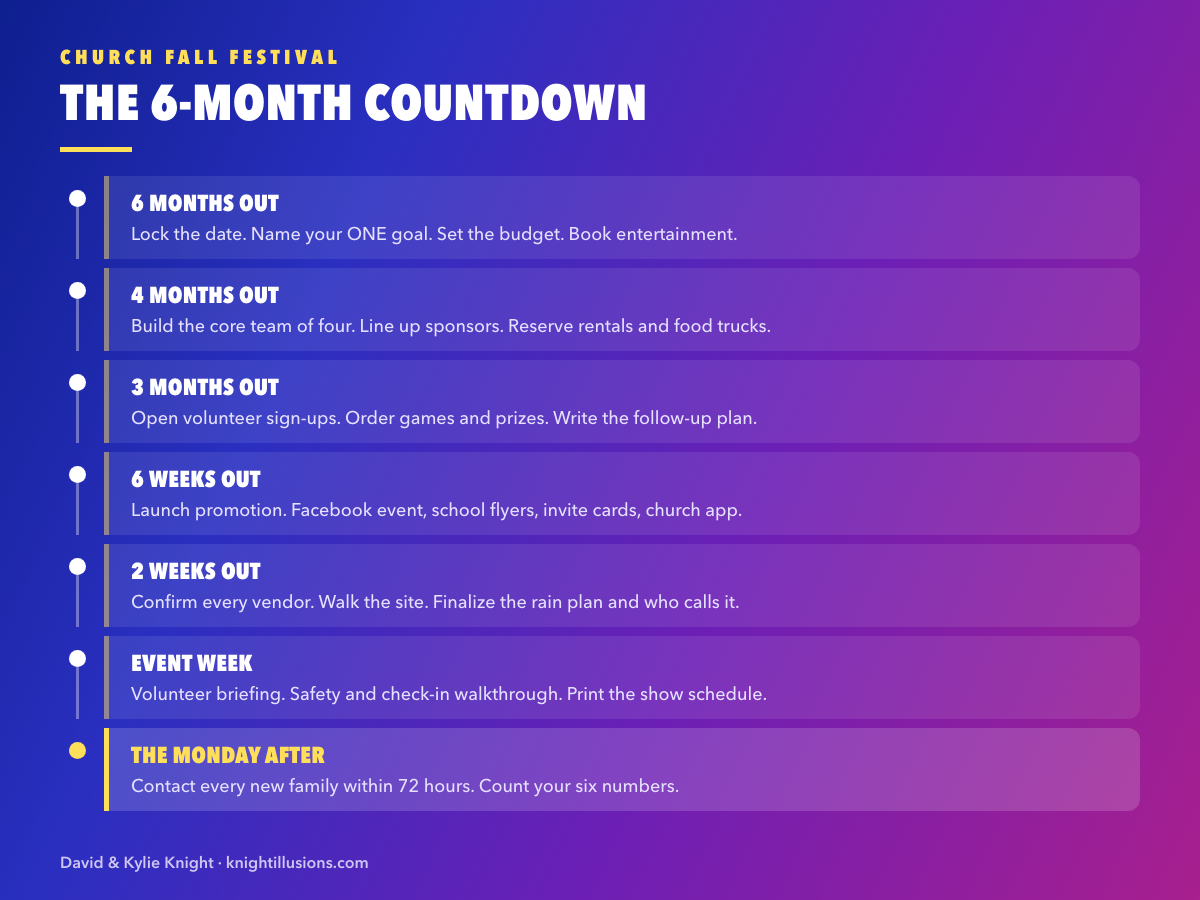
An excellent festival is honestly just excellent project management. Build a core team of about four leaders, each owning one area:
- Food (menu, trucks, food safety, serving volunteers)
- Activities (games, booths, prizes, layout)
- Promotion (community invitations, social, signage, print)
- Guest experience (parking, greeters, check-in, the scheduled event, follow-up)
That fourth one is the role most churches do not create, and it is the one that turns a party into an outreach. Somebody has to own the first ninety seconds and the next seven days.
Underneath those four, here is a volunteer shape that works. Scale it to your size:
| Role | Roughly how many | What they actually do |
|---|---|---|
| Parking and greeting | 4 to 8 | Wave cars in, say hello, point at things, smile a lot |
| Check-in and wristbands | 2 to 4 | Kid wristbands, parent tags, answer the “is this free?” question |
| Booth and game hosts | 2 per booth | Run the game, hand out prizes, keep the line moving |
| Food service | 4 to 10 | Serve, restock, watch allergies, keep tables clean |
| Floaters | 2 to 4 | Cover breaks, run supplies, handle the unexpected |
| Safety and lost child | 2 plus your security team | Watch the perimeter, own the lost child plan |
| Setup crew | 8 to 15 | The afternoon before and the morning of |
| Tear-down crew | 8 to 15 | Recruit these separately. Never assume setup people will stay |
| Follow-up team | 3 to 5 | Do not serve on the night. They work the Monday after |
Two of those rows are the ones churches skip and regret. Recruit your tear-down crew as its own team with its own sign-up. And keep your follow-up team off the roster for the night, because people who worked a six-hour event do not make warm phone calls on Monday.
Choose leaders with strong social, organizational, and leadership skills, then let them build sub-committees appropriate to the size of your event. Pull in as many families as you can at the planning stage. People who help plan it show up to run it.
7. Can you staff this without burning out your volunteers?
Let your volunteer pool determine the size of your event, not your ambition. It is far better to run a tight, joyful, well-staffed festival with eight booths than a sprawling one with twenty booths and exhausted, resentful people.
Ask the honest question: if this event costs us our volunteers for the next three months, was it worth it? Because that is a real cost, and it shows up in November when nobody wants to sign up for anything.
Some ways to widen the pool:
- Recruit teen volunteers from nearby middle and high schools who need service hours for graduation.
- Give every volunteer a defined shift with a start AND an end time, so they get to enjoy the event too. Two-hour shifts beat one four-hour shift for the same number of hours served.
- Feed your volunteers. Actually feed them, with real food, somewhere they can sit down.
- Use a free online sign-up tool like SignUpGenius.com with clear categories: activities, food, setup, tear-down, follow-up.
- Look hard at which elements are volunteer-hungry and which are not. A scheduled show, a hired inflatable, or a food truck delivers a big experience on a small staffing footprint. A trunk or treat with forty trunks does not.
- Thank people specifically and by name the following Sunday. It is the cheapest recruiting you will ever do for next year.
Recruitment gets dramatically easier once your event becomes a tradition. Year three is much easier than year one.
8. Games, prizes, and food people talk about
You do not have to reinvent the wheel. Decide first whether you are buying carnival games from a supplier or building them, because that decision drives your timeline more than almost anything else. Building your own is cheaper, more creative, and a wonderful excuse to get families working together in a garage on a Saturday. It also needs to start in August, not the first week of October.
A few things worth knowing before you plan the games:
- Line length is the real enemy. One popular booth with a thirty-minute line will sour a family’s whole night. Duplicate your best game rather than adding a new one.
- Little kids need their own zone. Toddlers get trampled at a booth designed for ten-year-olds, and their parents leave early.
- Have something for teenagers, or they will stand around the edges and their families will not come at all.
- Non-candy prizes matter. Stickers, glow sticks, bubbles, small toys. Some kids cannot have the candy, and every parent notices which churches thought about that.
Then take food seriously. Food is the most commonly under-planned part of a church festival and one of the most memorable. Traditional festival food still wins: popcorn, pretzels, cotton candy, shaved ice, caramel corn, candy apples. For a cool evening, hot apple cider and hot chocolate are worth every bit of the effort.
And call your local food trucks. Many are glad to park in a church lot for an evening with a guaranteed crowd, and it costs your team nothing to coordinate but a phone call and a parking space.
9. Is your event genuinely safe, and does a first-time family feel found?
This is the section that did not exist in most festival guides ten years ago, and it is now the one that matters most for reaching new families.
Parents are evaluating you. Make it easy for them to say yes.
- Have a security plan and a visible team. Talk with your local police department. Many will send an officer or a patrol for a community event, and several will do it at no charge.
- Have a children’s check-in, even a simple wristband system with a matching parent tag, and say so in your promotion. “Wristband check-in for every child” is one of the most reassuring sentences you can put on a flyer.
- Have a lost child plan that every volunteer knows before doors open, including one named meeting point and one person who owns it.
- Post allergy information on your food tables, and keep a clearly marked allergy-friendly table.
- Light your parking lot and your walkways, and put a human being at every turn a car has to make.
- Make your signage obvious and friendly. Restrooms, stroller parking, water, the schedule, and where the free stuff is.
- Have accessible paths. Grandparents and strollers are both coming.
- Have a first aid station and at least one person who knows where it is at all times.
- Know your quiet space. Somewhere calm and low-stimulation for a kid who is overwhelmed. Families who need this one will remember your church forever.
10. How will you invite your community, and what happens Monday morning?
The inviting part:
Start four to six weeks out and layer it. No single channel is enough.
- Create a Facebook event and ask your whole congregation to share it. Boost it geographically to a few miles around your campus. A very small ad budget goes a long way on a free, local family event.
- Send flyers home through local elementary schools three to four weeks ahead, where your district permits it.
- Give your own church family physical invitation cards to hand out. Ask everyone to invite ONE family by name. That single ask outperforms every ad you will ever run.
- Reach out to local TV and radio. They are always looking for good community stories, and a free family event at a church is a good community story.
- Ask your sponsors to promote it too. They have customer lists and storefront windows.
- Put it on your church app, your text list, and your Sunday announcements for three straight weeks.
- Put a sign at the road. People drive past your building every day without knowing you exist.
- Feature the SPECIFIC things: the schedule, the food trucks, the inflatables, the free photo booth. “Fall Festival, 6pm” is not an invitation. “Free family night, food trucks, inflatables, and a live show at 7:00” is.
The Monday part, which is the whole point:
If you do nothing else in this guide, do this. Decide your follow-up system BEFORE the event, not after.
- Give people a reason to give you their information. A prize drawing, a free family photo, a raffle for a gift basket. Put a QR code on every table that goes to a simple form. Make it take fifteen seconds.
- Have a specific, low-pressure next step ready to invite them to. Not “come to church sometime.” Something with a date on it. A family movie night, a Thanksgiving outreach, a kids’ program kickoff, a Christmas service.
- Contact every new family within 72 hours, while they still remember the night.
- Assign the follow-up to real names before the event happens. A list of forty new families and nobody assigned to them is not a harvest, it is a pile of paper in the church office.
Copy and paste: your follow-up messages
Write these in September, not the Monday after. Change the words so they sound like your church, then hand them to your follow-up team with the names already assigned.
Text message, within 72 hours:
Hi [Name], this is [Your name] from [Church]. We loved having your family at the Fall Festival on Friday! Hope the kids came home happy and covered in cotton candy. If you’re ever looking for somewhere to land on a Sunday, we’d love to save you a seat. No pressure at all, just glad you came.
Email, within 72 hours:
Subject: So glad your family came Friday!
Hi [Name],
Thank you so much for coming out to our Fall Festival! We had [number] people on our campus and it was such a joy to have your family be part of it.
No agenda with this email. We just wanted you to know you’re welcome here any time, and if you ever want somewhere for your family on a Sunday morning, our doors are open at [time].
One thing coming up that might be fun for your family: [specific next event, with the date]. Totally casual, kids are very welcome, and there will be food.
Thanks again for spending your Friday night with us.
[Name]
[Role, Church, phone]
The two-week nudge, only if they have not responded:
Hi [Name]! [Your name] from [Church] again. Just a quick note that [specific event] is this [day] at [time]. We’d love to see your family there if the timing works. Either way, we’re glad we met you.
Three rules for all of it. Keep it short. Make one specific invitation with a date on it. And stop after the second message unless they respond, because the difference between a warm church and a pushy one is entirely in whether you can take a hint.
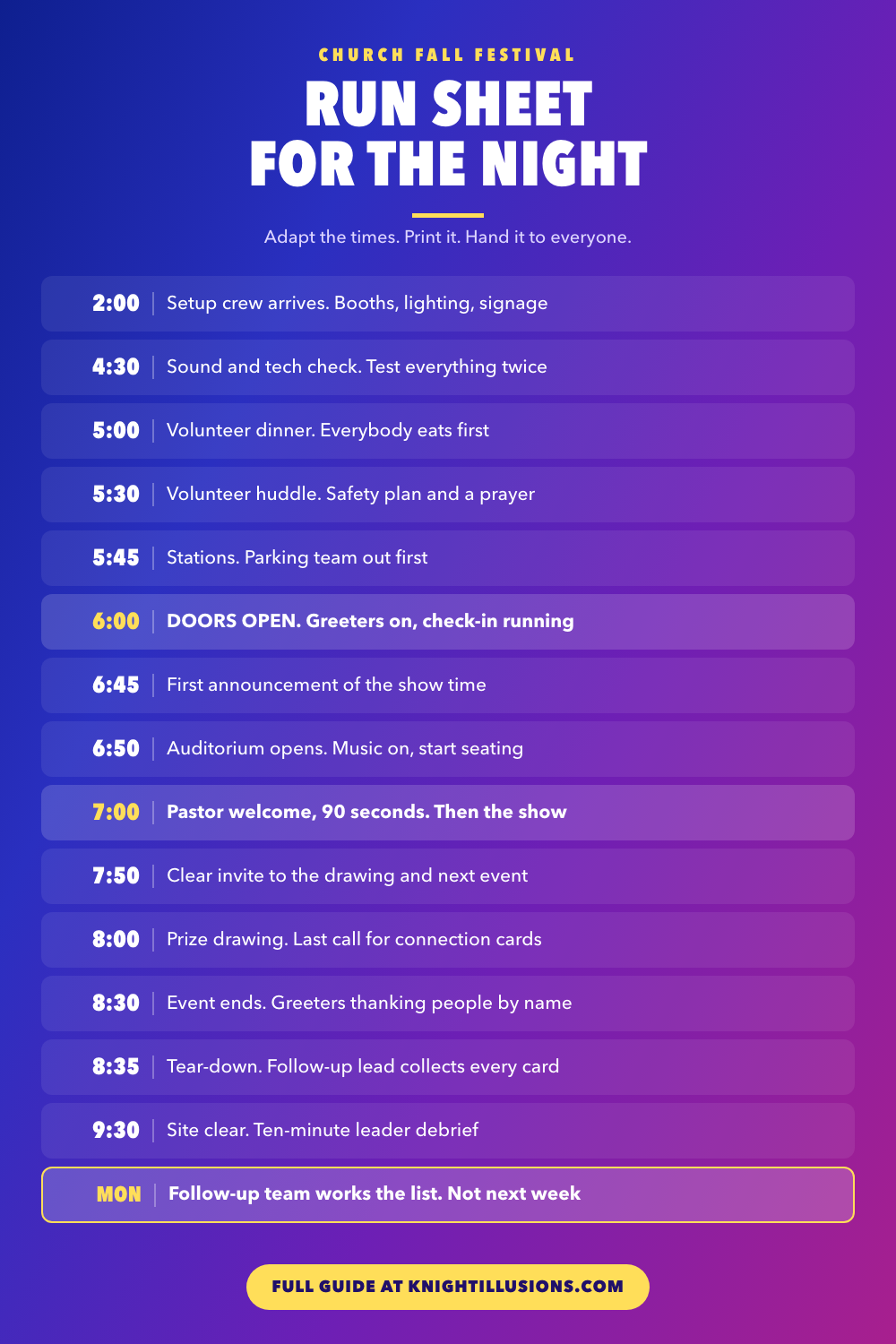
A sample run sheet for the night
Adapt the times to your own event, print it, and put a copy in every volunteer’s hand. The single biggest difference between a smooth night and a chaotic one is whether people know what happens next.
| Time | What is happening |
|---|---|
| 2:00pm | Setup crew arrives. Booths, tables, inflatables, signage, lighting check |
| 4:30pm | Sound and tech check in the auditorium. Test everything twice |
| 5:00pm | Volunteer dinner. Everybody eats before the doors open |
| 5:30pm | Volunteer huddle. Safety plan, lost child plan, schedule, and a prayer |
| 5:45pm | Everyone to stations. Parking team out first |
| 6:00pm | Doors open. Greeters on, check-in running, music playing |
| 6:45pm | First announcement of the show time, from the stage and at every booth |
| 6:50pm | Auditorium doors open, music on, start seating people |
| 7:00pm | Pastor welcome, 90 seconds. Then the show or main event |
| 7:50pm | Show ends. Clear invitation to the prize drawing and the next-step event |
| 8:00pm | Booths reopen briefly, prize drawing, last call for connection cards |
| 8:30pm | Event ends. Greeters at the exits, thanking people by name |
| 8:35pm | Tear-down crew starts. Follow-up lead collects every card and QR submission |
| 9:30pm | Site clear. Leaders debrief for ten minutes while it is fresh |
| Monday | Follow-up team works the list. Nobody waits until next week |
That last row is not optional. It is the row the entire event was for.
What to measure (your festival scorecard)
Attendance is the number everybody quotes and the number that tells you the least. Here is what we would track instead:
| What to count | Why it matters |
|---|---|
| Families who had never been on your campus | The actual outreach number |
| Contact details captured | Your only bridge to the Monday after |
| Follow-up conversations within 72 hours | Whether you built a bridge or a memory |
| Families back within 30 days | The real return on the whole night |
| Volunteers who would serve again | Whether this is sustainable or a one-off |
| What your team would change next year | The list you will not remember in August |
Write these down the week after the event, while it is fresh. Next September, that single page will be worth more to your team than anything else in your files.
A word about the gospel moment
This is the part church leaders agonize over most, and understandably so. You invited your neighbors to a free family night. Nobody wants a bait-and-switch, and nobody wants to waste the one night a year those families are standing in your building either.
Here is what we have watched work, across a lot of churches and a lot of fall nights.
Be honest in the invitation. If there will be a few minutes of someone sharing, say so in your promotion. “A fun night for the whole family, with a short encouraging message” is honest, and almost nobody stays home because of it. What people resent is being surprised.
Short beats long, every time. Five to eight minutes, inside an evening that has been genuinely fun, will land harder than twenty-five minutes that turns a festival into a service.
Aim at one idea, not a whole sermon. A family sitting there with a tired four-year-old can carry home exactly one thought. Make it a good one.
Give a next step that is not scary. A card to fill out, a person to talk to by the door, an event with a date on it. Something a curious person can do without having to declare anything in front of their kids.
Then genuinely let them go. No pressure, no repeated appeals, no closing the doors. The families who felt respected on Friday are the ones who show up on Sunday.
If you are bringing in outside help for that moment, ask them exactly what they plan to say and ask to see it on video first. A professional will hand that over without being asked twice.
If you are a smaller church
Most festival advice is quietly written for churches with three hundred volunteers and a parking team. If that is not you, almost none of this changes, but a few things get simpler.
- Do fewer things extremely well. Six great booths, one excellent food option, and one scheduled thing everybody gathers for will beat a sprawling event you cannot staff.
- Partner up. Two or three small churches running one strong community festival together reaches more families than three thin ones on the same night, and it is a beautiful witness in a small town.
- Lean on the things that do not need volunteers. A food truck, a rented inflatable, a scheduled show. These deliver a big experience on a small staffing footprint.
- Your advantage is real and it is enormous. At a small church, a first-time family actually gets known. Nobody disappears into the crowd. Follow-up is easier, warmer, and far more likely to work. Play to that instead of trying to look bigger than you are.
Choosing your entertainment: what to actually ask
When you bring in outside entertainment, you are handing a stranger your church’s name, your platform, and the first impression of every guest in the room. That is a big deal, and it is worth doing carefully.
Ask every entertainer you consider:
- Have you performed for churches, specifically? Church events are their own world. Someone who mostly works birthday parties and corporate mixers will not instinctively know how to handle a mixed-age church crowd, a pastor’s welcome, or a gospel moment.
- What is your show like for a crowd from 4 to 84? A festival crowd is every age at once. A show pitched only at kids loses the adults in eight minutes, and the adults are the ones who decide whether the family comes back.
- Do you present a gospel message, and what exactly does it sound like? Ask them to describe it, then ask to see it. You are looking for clear, short, and warm.
- Can I speak to three churches you served this year? Then actually call them. Ask what went wrong and how it got handled, because something always goes a little wrong.
- What do you need from us? Stage size, sound, lighting, power, load-in time, setup window. A professional will have a written technical rider and will send it without being chased.
- Are you insured? Yes, ask. A professional carries liability insurance and will not be offended.
- What is your cancellation and weather policy, in writing?
- How do you handle a product table? Decide together what is appropriate for your church and your crowd, in advance.
- What do you do to help us promote it? The good ones hand you images, posters, and video before you ask.
Want the longer version of this checklist? We wrote a short book on exactly this, 5 Golden Keys to Choosing Your Next Christian Entertainer, covering how to read testimonials properly, how to vet the message before you book it, how to see past slick promo material, what an entertainer’s process tells you about them, and the reference questions that get you the unfiltered truth. It is free, and it is yours here: Get the free book.
What churches say about their fall events
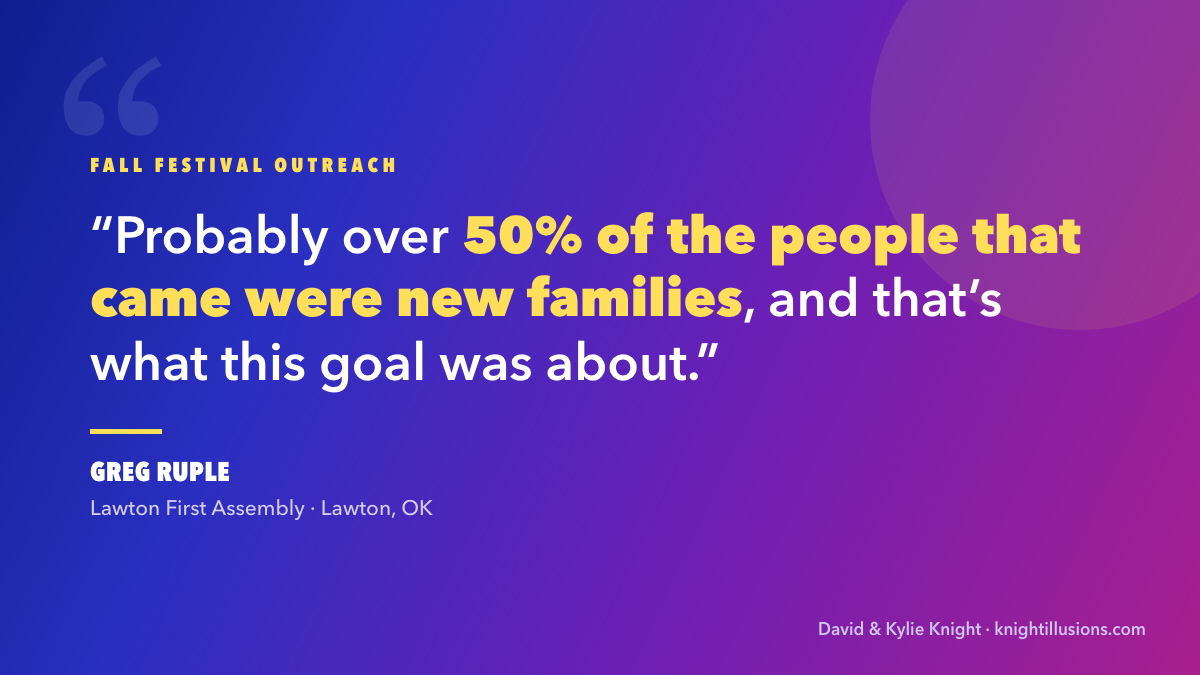
“Probably over 50% of the people that came were new families, and that’s what this goal was about.”
Greg Ruple, Lawton First Assembly, Lawton, OK (Fall Festival Outreach)
“We had a draw of hundreds of people that came that we had never seen before to see the Knights.”
Danielle Biser, Southcliff Baptist Church, Fort Worth, TX (Fall community carnival)
“I saw parents holding on to their kids and holding hands and laughing and loving each other.”
Roger Ellis, Children’s Pastor, Southcliff Baptist Church, Fort Worth, TX (Fall Ball)
“We had over 1500 people on our campus.”
Sheik Ally, Calvary Orlando, Orlando, FL (Fall Festival Outreach)
“We had them here for our Fall Fest Trunk and Treat. We had them booked for back-to-back events.”
Michael Borton, First Baptist Church, Shallotte, NC
“They did a phenomenal job bringing families together, letting them have an opportunity to come, get to one service and just have a lot of family fun. The show was just amazing. We were mind blown.”
Chesney Dorsey, Family Ministry Pastor, Stockbridge Community Church, Stockbridge, GA
“They get ministry. They get churches. They’ll be everything you need.”
Daniel Harper, Pastor, Northside Baptist Church, Corsicana, TX
“It has given us the opportunity to get to know families that don’t come to our church and build a relationship with them. We are so excited for the future of the church.”
Sheik Ally, Calvary Orlando, Orlando, FL
Consider raising money for something bigger than the night
Festivals draw crowds, and a crowd is an opportunity to do good beyond your own campus. A fall festival is a natural place to gather support for a local charity, a school need, or a missions partner.
If you are bringing in entertainment, ask whether they have a cause they support. We are Global Ambassadors for Uganda Shoe Trees, a ministry breaking the cycle of poverty in rural Uganda, and we love folding a giving moment into a night when a whole community happens to be standing in one place.
Frequently asked questions
How far in advance should we plan a church fall festival?
Start six months out for the big decisions (date, goal, budget, entertainment) and three months out for the details (volunteers, booths, food, promotion). If you want a specific entertainer or food truck for an October Friday or Saturday, six to twelve months is realistic.
Should we call it a Trunk or Treat, a Harvest Festival, or a Family Fun Night?
Whichever one your community will understand and your congregation will support. Trunk or Treat is the most recognized name in the neighborhood. Harvest Festival avoids the Halloween conversation. Family Fun Night puts the focus on families being together and works well for an indoor, scheduled event.
Should our fall festival be free or ticketed?
If your goal is reaching new community families, free removes every barrier and is almost always right. If your goal is a fundraiser or an evening show with a set start time, ticketing is reasonable and can even help. Churches have had real success selling low-cost tickets for a scheduled show while keeping the outdoor festival itself completely free.
How do we get people from the parking lot into our building?
Give them a scheduled reason with a time attached, announce it all night, and make sure it does not compete with your biggest outdoor attraction. Something happening in your auditorium at a set time is the most reliable way we know to do this.
How do we follow up with new families without being pushy?
Reach out once within 72 hours, warmly and briefly, with one specific invitation that has a date on it. Nudge once about two weeks later. Then stop unless they respond. There are copy-and-paste messages for all three above.
What if it rains?
Decide your Plan B in September, not on the day. Name the indoor location, name the one person who makes the call, name the time of day they make it, and name how everyone finds out. Write all four down and tell your volunteers in advance.
How many volunteers do we need?
Let your volunteer pool set the size of your event rather than the other way around. There is a role-by-role breakdown above, and the two teams churches most often forget are tear-down and follow-up. Recruit both separately.
What is the single biggest mistake churches make with fall festivals?
Not deciding what happens Monday morning. Enormous energy goes into one incredible night, hundreds of people come, and there is no plan to capture a single name or invite anyone to a specific next thing. Decide your follow-up system before you buy the first bag of candy.
Who we are, quickly

We are David & Kylie Knight, a husband-and-wife Christian illusionist team, and we have been touring full-time for over fifteen years. We have partnered with hundreds of churches across the country, from congregations of about a hundred people up through mega-churches like Southeast Christian and Prestonwood.
We are not just performers who happen to be Christians. We are ministry partners who happen to be REALLY GOOD at illusion!
For a fall festival, what we do is the thing this whole guide is about: give your community a reason to come inside, sit down together, and be genuinely delighted, then share a short, clear, warm moment that points to their value as people made in the image of God. Then we get out of the way so your church can do what your church does.
We work directly with you. No agents, no middlemen. Just the two of us, from the first phone call to the last curtain.
Go have a great fall
Whether we ever meet or not, we hope this guide saves your team some arguments and some late nights. Your fall festival can be so much more than a great night. With a clear goal, a real follow-up plan, and something genuinely worth coming inside for, it can be the front door that reshapes your next year of ministry.
Print the run sheet. Steal the follow-up messages. Give your tear-down crew their own sign-up. And go do something wonderful for your community.
If we can help, we would love to hear about your vision for this event and show you exactly how we can bring it to life.
Ready to create an event your church and community will be talking about for MONTHS to come?
SCHEDULE A QUICK CONVERSATION
15 minutes, no obligation. Just pick a time that works for you.
📞 214-257-0903
✉️ info@knightillusions.com
📘 Get the free book: 5 Golden Keys to Choosing Your Next Christian Entertainer
David & Kylie Knight are America’s premier Christian illusionist team. They travel full-time, partnering with churches nationwide for Family Fun Nights, fall festivals, volunteer appreciation events, camps, and community outreach.